03 / R&D acceleration
R&D Platform
AI-Native Research Infrastructure
An AI-powered R&D platform that compresses the work between discovery and translational evidence. Autonomous experimentation with Bayesian optimisation. Institutional memory that grows with every experiment. Four scanning engines. Quality intelligence. Regulatory documentation generated from the evidence itself.
Status — The R&D Platform is in active development. Current demo showcases the mRNA vaccine pipeline.
90-day pipeline — target to IND
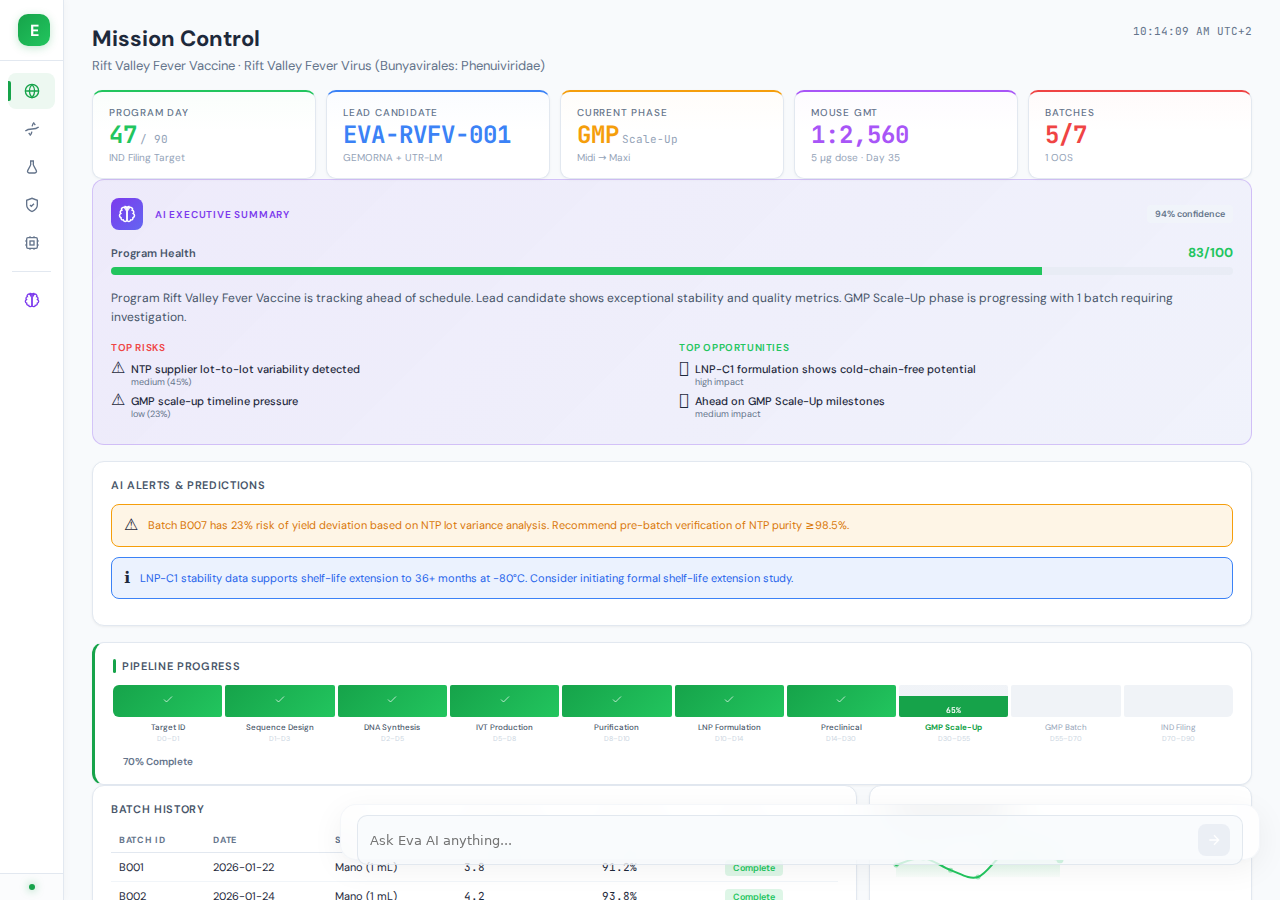
Mission Control Dashboard
01 / 7
Real-time programme overview showing current day (42/90), active phase (GMP Scale-Up), lead candidate (EVA-RVFV-001), and a 10-stage pipeline progress bar from Target ID through IND Filing. Animated charts track yield, integrity, and dsRNA across batches.
- Programme: EVA-RVFV-2026 — Rift Valley Fever Virus vaccine
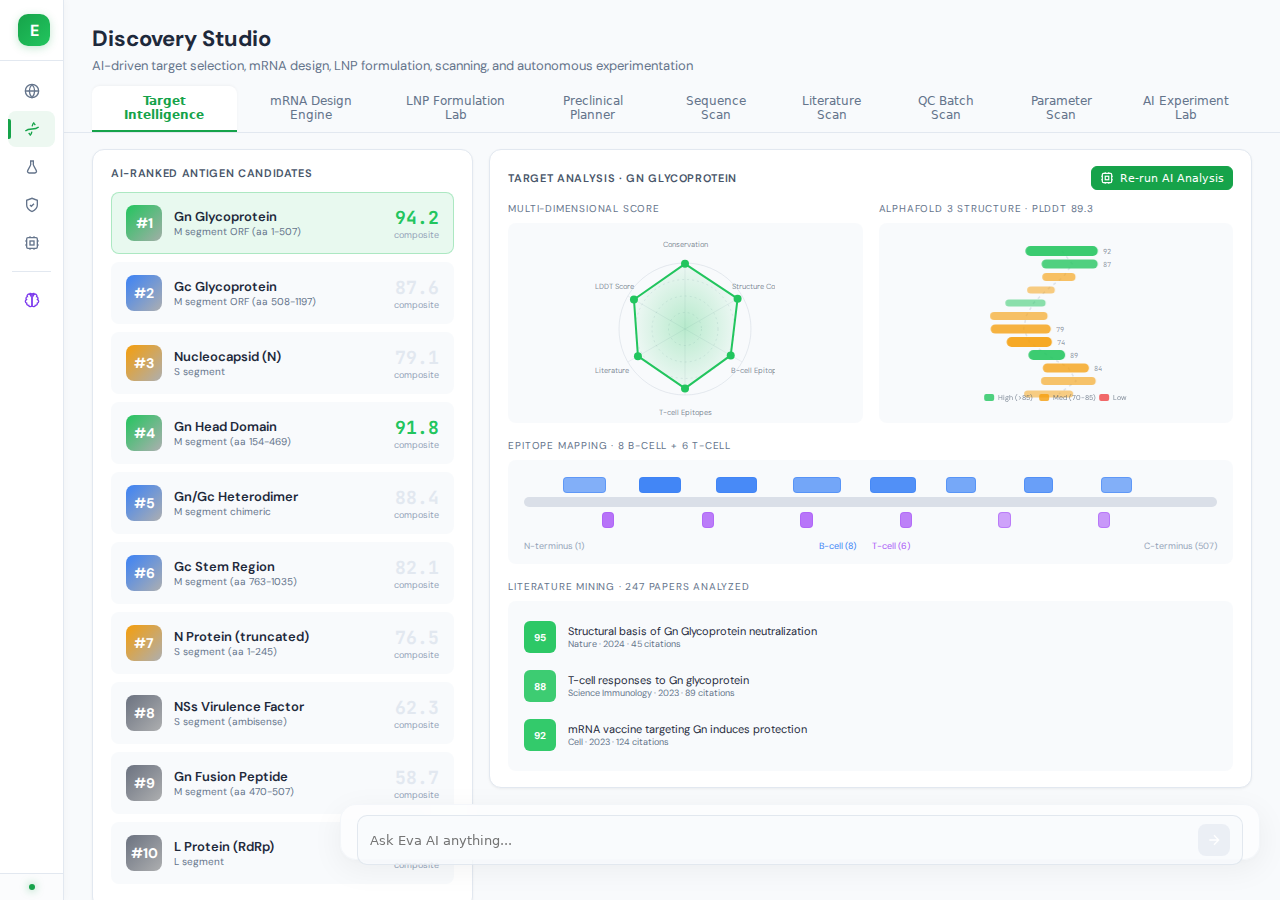
- Lead candidate: Gn Glycoprotein, Composite Score 94.2
- Enterprise AI metrics: 84% adoption, 47 agents, 2,340 queries/week
- Live activity feed with cross-module notifications
Autonomous AI Scientist
02 / 7
Bayesian-optimised experiment campaigns that design, execute, and analyse experiments autonomously. Four campaign templates — LNP optimisation (47 runs), IVT tuning (89 runs), codon optimisation, and stability studies — each with multi-objective Pareto frontier analysis.
- Acquisition functions: UCB, Expected Improvement, Probability of Improvement
- Auto-run mode: AI executes campaigns in the background
- Real-time experiment results table with parameter scores
- Pareto frontier visualisation for multi-objective trade-offs
Four Scanning Engines
03 / 7
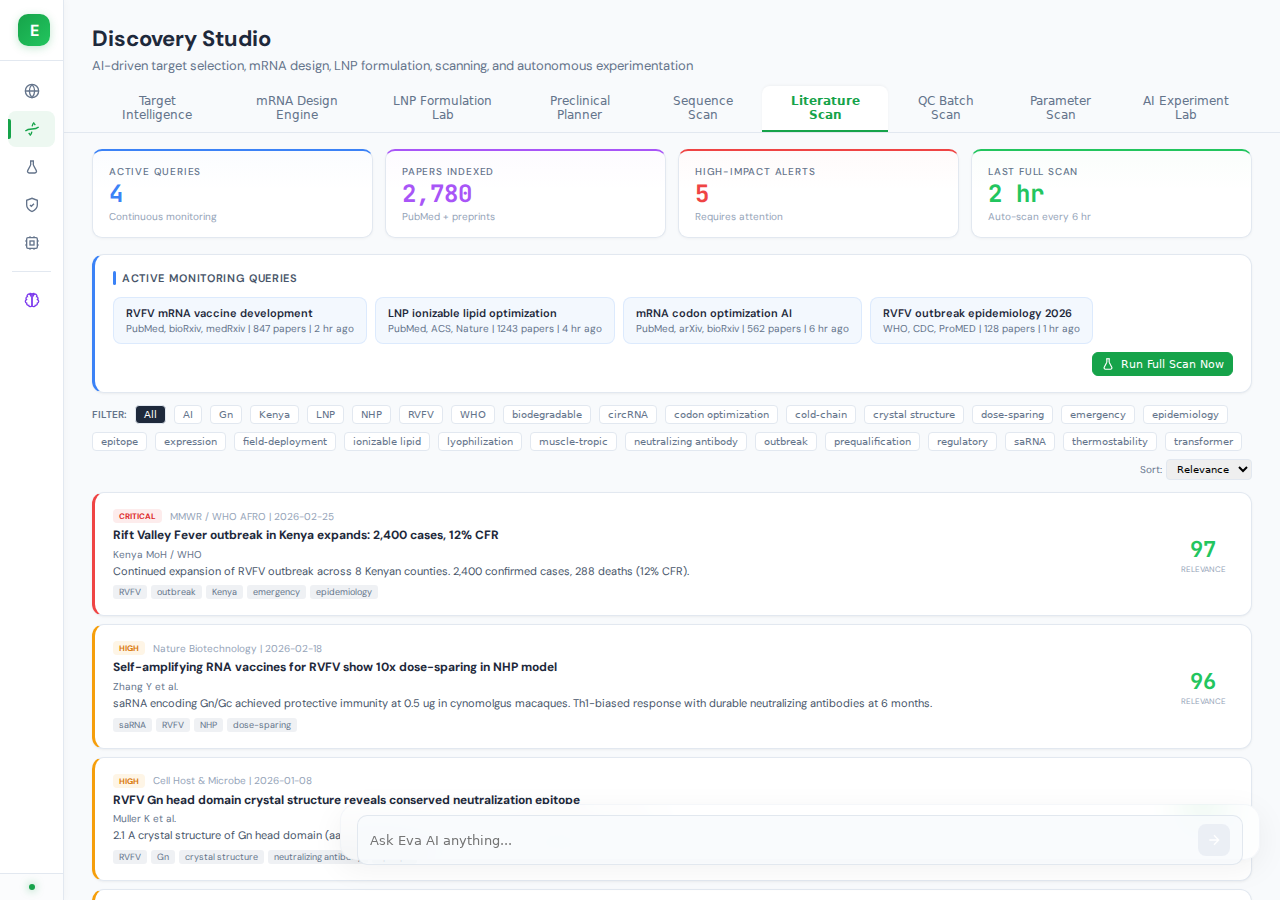
Sequence Scan detects 24 regulatory motifs (Kozak consensus, AU-rich elements, G-quadruplex) with immunogenicity profiling (TLR3, TLR7/8, RIG-I, MDA5). Literature Scan monitors 2,780 indexed papers. QC Batch Scan tracks trends with OOS detection. Parameter Scan maps the full design space.
- Sequence Scan: 1,521 nt analysed, stability score 94.2, innate immune risk Low
- Literature: 6 active monitoring queries, high-impact alerts
- QC Batch: Cpk 1.42, 1 anomaly (Batch B004 MgCl₂ deviation)
- Parameter Scan: MODR identified for IVT and LNP parameter spaces
IVT Digital Twin
04 / 7
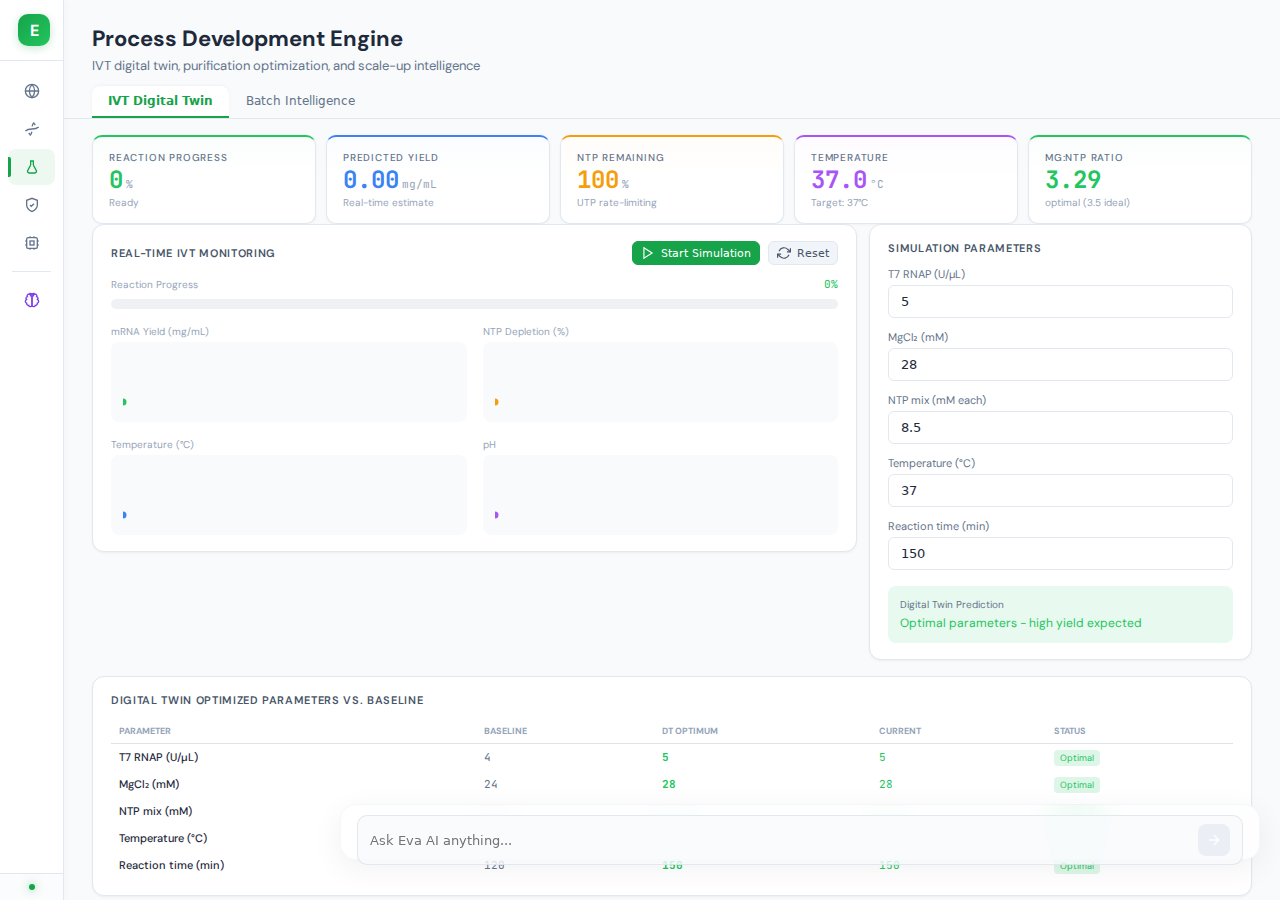
Real-time simulation of the in-vitro transcription reaction. Shows predicted mRNA yield, NTP consumption, temperature, and pH. Adjustable parameters: T7 RNAP, MgCl₂, NTP mix, reaction temperature, and duration. Baseline vs. digital-twin optimum comparison table.
- Real-time animated charts: yield curve, NTP depletion, temperature profile
- Mg:NTP ratio validation with colour-coded status
- Parameter comparison: baseline → DT optimum → current
- Start/Reset simulation controls
LNP Formulation Lab
05 / 7
Lipid nanoparticle formulation comparison with Bayesian optimisation convergence tracking. Six formulations tested across ionisable lipids (SM-102, ALC-0315), helper lipids (DSPC, DOPE), with particle size, PDI, encapsulation efficiency, and transfection data.
- LNP-B1: SM-102+DSPC, 73.2nm, 96.5% EE
- LNP-D1: SM-102+DOPE, 74.5nm, 94.2% EE, lyophilised
- Optimisation: cumulative candidates screened, top transfection by cycle
- Auto-launches AI Scientist campaign on new formulation
Institutional Memory & Knowledge Graph
06 / 7
Six memory stores (Knowledge Graph 427 items, Batch DB 23 batches, Literature 847 papers, Regulatory 34 docs, Experimental 156 results, Sequences 1,240) with typed entity relationships. 15 autonomous discoveries generated by background analysis.
- Discovery types: Optimisation, Anomaly, Correlation, Recommendation, Hypothesis, Prediction
- 9 pending hypotheses including thermostable LNPs and circular RNA design
- Activity stream with cross-store correlation events
- Memory grows with every experiment — platform learns from its own history
Quality, Regulatory & Stability
07 / 7
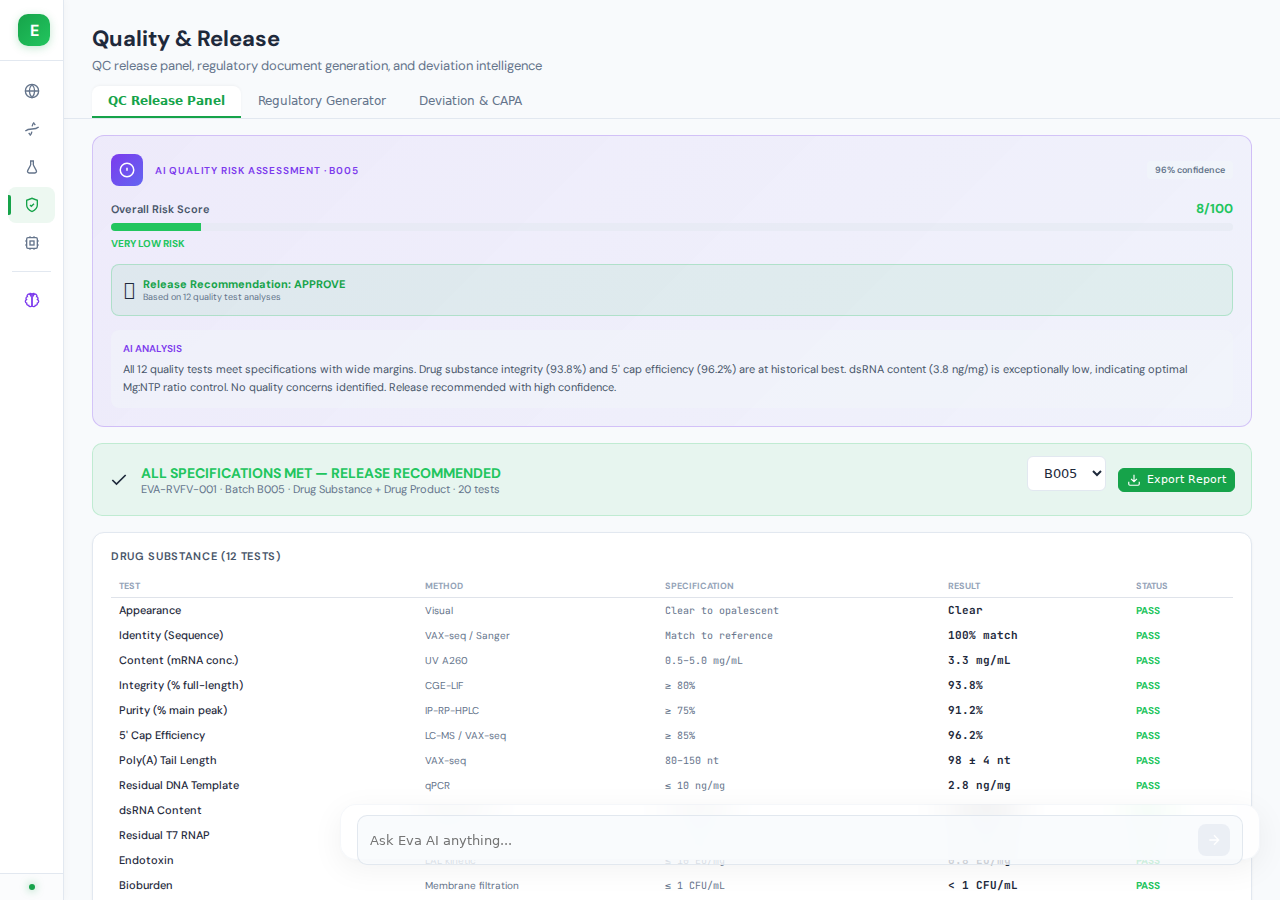
QC panel with AI risk scoring (0–100) across 20 analytical tests. Regulatory CMC document generator with editable templates (3.2.S.4.1, 3.2.S.2.2, 3.2.P.3.3). Deviation/CAPA with AI root cause analysis. Multi-temperature stability predictions (-80°C: 36+ months, 2–8°C: 5.2 months).
- QC: pass/fail indicators, status summary (RELEASE RECOMMENDED / HOLD)
- Regulatory: AI suggestions for clarity and references, export as JSON
- CAPA: Batch B004 deviation analysis with immediate (48h) and preventive (2 week) actions
- Stability: degradation curves at 4 temperatures with particle size growth tracking
Screenshots

The AI scientist that never stops learning
The platform's AI Scientist runs autonomous experiment campaigns using Bayesian optimisation. It designs experiments, simulates results, analyses outcomes, and adjusts its strategy in a closed loop. LNP formulation optimisation. IVT process tuning. Codon optimisation. Stability studies. Each campaign generates discoveries that feed the institutional memory.
The knowledge graph connects every entity — targets, candidates, formulations, batches — with typed relationships. Discoveries, hypotheses, and episodes accumulate over time. The platform literally learns from its own history, making each subsequent campaign more efficient than the last.
Configurable for any R&D domain
The platform's three-layer architecture separates structure from data. The Platform layer handles entities and CRUD. The Memory layer manages institutional learning. The Agentic AI layer drives autonomous behaviour. What changes between domains is the data that flows through — not the code.
The current demo showcases mRNA vaccine development for Rift Valley Fever Virus through Eva Pharma Egypt. The same platform can be configured for materials science, semiconductor fabrication, or any domain where AI-accelerated R&D can compress timelines without compromising rigour.